
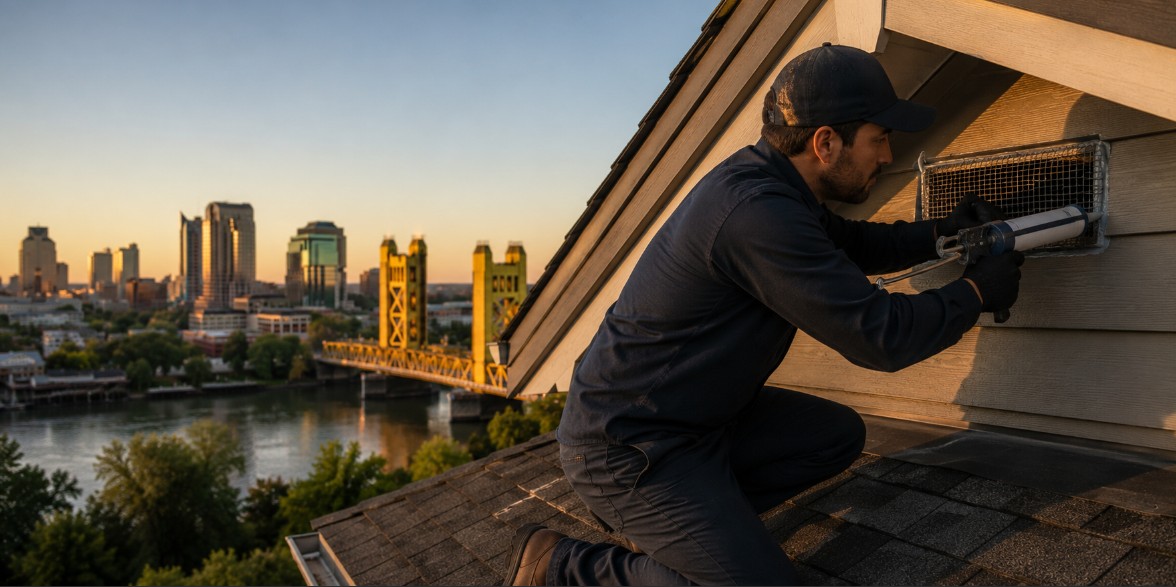
Rodent Exclusion and Rodent Proofing in Sacramento
We find every opening a rat or mouse can use and close it in metal or mortar, from the foundation vents to the ridge.
- Every opening over a quarter inch
- Metal and mortar, never foam alone
- Vents stay open to air and closed to rodents
- Licensed and insured
Trapping removes the rats you have. Exclusion stops the next ones, and here there are always next ones: in the citrus tree, on the back fence, along the river. University of California pest advisers call sealing the building the most successful and longest-lasting way to control rats.
Rodent exclusion and rodent proofing are the same job. Every opening a rat or mouse could use gets closed with something it can't chew through. The skill is in finding them all, because one missed gap undoes the rest.
What a rat or mouse can get past
It helps to know what the house is up against.
Squeeze
A young rat fits under a door with a half-inch gap. A mouse needs a quarter inch.
Climb
Rats and mice go up almost any rough wall: wood, brick, concrete. A rat can climb the outside of a pipe up to three inches across, and it runs wires and vines like a path.
Jump
A rat can jump about three feet straight up and four feet across.
Chew
Wood, plastic, foam, caulk and the rubber or vinyl seal on the bottom of a door are all on the menu.
What we seal, and what closes it
| Opening | Where it shows up on Sacramento homes | What closes it |
|---|---|---|
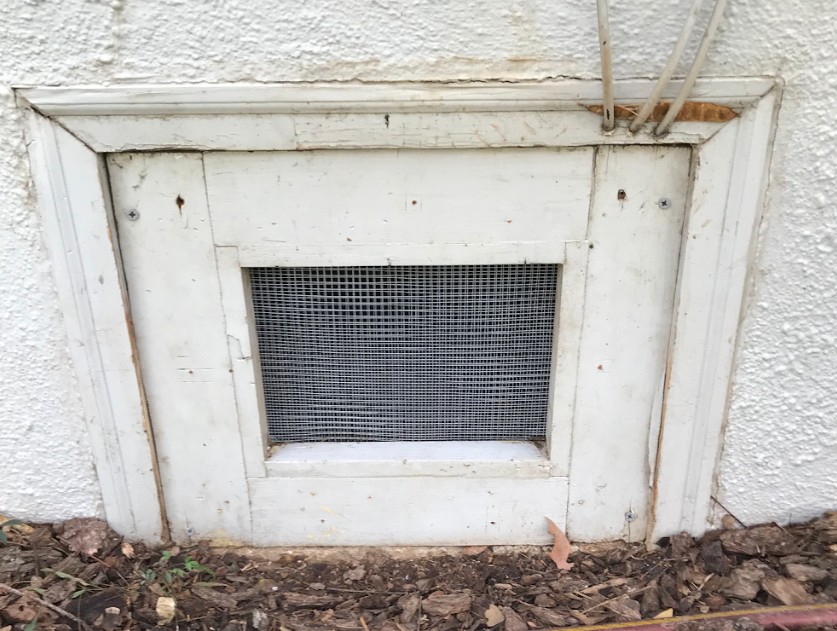
| Foundation vents | Raised-foundation homes, where old screens have rusted through | Galvanized hardware cloth fixed to the vent frame |
| Crawl space hatch | Under older houses in the central city | A tight-fitting cover with metal on the edges |
| Pipe, wire and gas line entries | Air conditioner lines, hose bibs, cable and gas | Copper or stainless mesh packed in, then mortar or sealant over it |
| Cracks and gaps in the foundation or siding | Sill lines, old additions | Mortar or concrete patch over a hardware cloth backing |
| Door bottoms and garage door corners | Nearly every attached garage | Metal-backed sweeps and thresholds, sheet metal on gnawed edges |
| Eave gaps and roof-to-wall joints | Where two rooflines meet on ranch homes | Sheet metal flashing and hardware cloth |
| Gable, roof and dormer vents | Mid-century houses with large gable louvers | Hardware cloth behind the louvers |
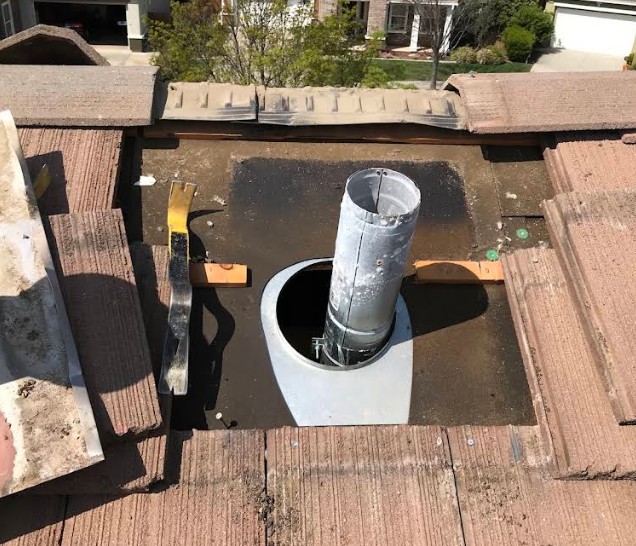
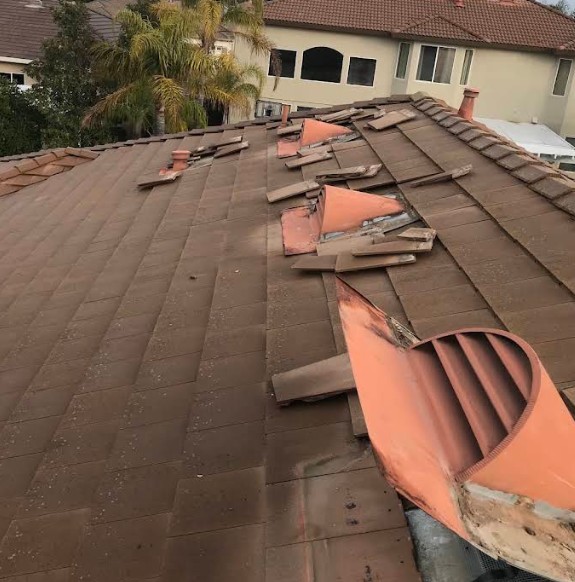
| Open tile ends at the eave | Tile roofs in Natomas and Elk Grove | Metal eave closures, also called bird stops |
| Plumbing vent pipes and chimneys | Any roof | Screens on pipes wider than two inches, a cap on the chimney |
| The space under solar panels | Newer roofs and retrofits | A wire mesh skirt around the array |
Materials that hold, and materials that fail
What goes in the hole matters as much as finding it.
These hold:
- Galvanized hardware cloth. Half-inch mesh in 19-gauge wire stops rats. Quarter-inch mesh stops mice.
- Galvanized sheet metal, 24 gauge or heavier.
- Copper or stainless steel mesh, for packing small gaps.
- Mortar and concrete patch.
These fail:
- Spray foam or caulk used alone. Rats chew straight through.
- Plastic, wood, and rubber or vinyl door seals.
- Chicken wire. It is too light, and the openings are big enough to walk through.
- Ordinary steel wool outdoors. It rusts away and stains the wall on the way.
Vents have to keep breathing
Vents are the one opening that can't simply be closed. A crawl space and an attic both need airflow, and the residential building code requires it. The same code calls for vent screens with openings no larger than a quarter inch.
On an older Sacramento house those screens have often rusted through, or were never that fine to begin with. The fix is new metal mesh on the vent. A board or a can of foam over it keeps the rats out and the moisture in.
Rodent proofing by type of Sacramento home
Raised-foundation homes
The high-water bungalows and older houses of Midtown, East Sacramento, Curtis Park, Oak Park and Land Park sit on crawl spaces and basements. Most of the work is low: the foundation vents, the hatch, basement windows, and every pipe that comes up through the floor. Then the roof, because these streets have big, mature trees and roof rats use them.
Mid-century single-story homes
In Arden-Arcade, Carmichael, Tahoe Park and South Land Park the work moves up. Gable vents, the valley where the garage roof meets the house, plumbing stacks, and the garage door itself.
Tile-roof homes on slabs
Natomas, Elk Grove and the newer parts of Rancho Cordova and Roseville have no crawl space to seal. The eave is the job: any tile end without a closure is an open door, and a roof has a lot of tile ends. Add the air conditioner line hole, the garage door and, more and more often, the solar array.
Apartments and duplexes
Rats and mice travel between units through shared walls and pipe chases. Sealing one unit moves the problem next door, so the building is planned as a whole.
What exclusion can't seal
- The sewer. In the old combined-sewer neighborhoods, rats can come up through a broken drain line. That repair belongs to a plumber.
- Trees and wires. We can't seal a branch. Limbs should be cut back at least three feet from the roof, and six is better. For rats using the overhead service line, the utility has to be involved.
- The yard. Exclusion keeps rats out of the house. It does not lower the number living in the ivy or eating the oranges.
Seal first or trap first?
Both, in a set order. Everything is sealed except the main route the rats are using. Traps go inside. When the traps stay empty, the last opening is closed.
Sealing every hole on the first day, with rats still in the attic, locks them in. See rodent trapping for how that side works.
Rodent proofing is not once and done
A sealed house stays sealed until something changes. Doors drop out of alignment. A roofer, a solar installer or a cable technician leaves a new hole. Trees grow back toward the roof.
Look the house over once a year, and again after any work on the roof or outside walls. September is a good month for it. October to February is when rodents most often move indoors.
How long the work takes
A slab house with a few openings can be sealed in one visit. A raised-foundation house with a dozen vents, a tile roof or a second story takes longer and is sometimes done in stages. Trapping runs alongside for two to six weeks.
What rodent exclusion costs in Sacramento
There is no flat price, because the job is counted in openings and every house has a different number. These move it most:
- How many openings. This outweighs everything else.
- The roof. Tile, steep pitches and second stories are slower and need more care.
- A crawl space. Vents, hatch and under-floor pipes add up.
- Length of eave. On a tile roof the closures are priced by the run.
- What else is in the job. Trapping, cleanup and insulation may be included or separate.
Compare quotes opening by opening, not total against total. A lower price that covers half the openings is not the cheaper job.
Our price comes in writing after the inspection, before any work starts.