
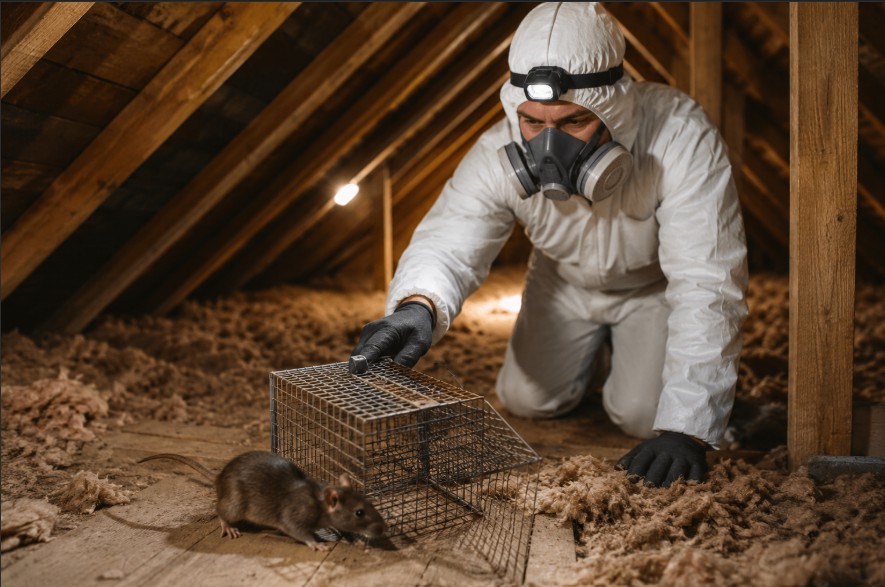
Attic Rodent Removal in Sacramento
Scratching over the bedroom after dark is almost always roof rats. We get them out, close the roofline, and clean up what they left in the insulation.
- ✓ Attic and roofline inspected together
- ✓ Trapped, never poisoned overhead
- ✓ Vents and eaves sealed in metal
- ✓ Licensed and insured
What is up there? Read the noise
You can usually name the animal before anyone climbs a ladder.
| What you hear | When | Most likely |
|---|---|---|
| Quick running and scratching, sometimes gnawing | After dark, heaviest in the first hours of the night | Roof rats |
| Very light scratching, often lower in a wall | Night | House mice |
| Scampering and rolling, like something dropped | Early morning and late afternoon | Tree squirrels |
| Slow, heavy thumping or walking | Night | A raccoon or opossum |
Why it is so often roof rats
Roof rats climb. They live in trees and reach a house from above, which makes the attic the first room they find. Norway rats live in the ground and mostly stay on the lowest floor, so they are a crawl space problem far more often than an attic one.
Two things about Sacramento make the trip easy.
SMUD has run power lines underground in new subdivisions since 1989. Neighborhoods built before that, such as East Sacramento, Land Park and Curtis Park, largely still have overhead lines running from pole to house, with mature trees growing through them. A roof rat treats a wire or a branch as a path.
On older houses the attic vent screens and the wood behind the gutters have had decades of summer heat and winter rain. On newer tile roofs in Natomas and Elk Grove the weak point is different: an open tile end at the eave. A new house is not a sealed house.
What rodents do to an attic
The damage is easier to understand part by part.
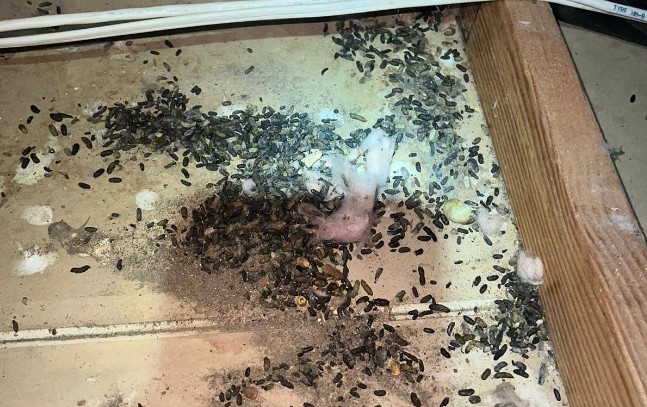
Rats tunnel through it, flatten it into runways and nest in it. Droppings and urine go where they go. Flattened, soiled insulation doesn't insulate the way it did, and it holds the smell.
In many Sacramento homes the heating and cooling ducts run through the attic. Rats chew into flexible duct and sometimes nest inside it. SMUD says leaky ducts in attics and crawl spaces can account for 20 percent or more of a home's energy losses. A chewed duct is a leaky duct.
That matters more here than in most places. A vented attic can reach 130 to 150 degrees on a summer afternoon. Cooled air leaking into that space is money gone.
Rodents gnaw wire. University of California pest advisers warn that this can start fires. Flickering recessed lights under an attic with rodent signs deserve an electrician's look.
A yellow-brown stain on a ceiling with no roof leak above it, or a smell that is stronger near the hallway hatch, means the problem has gone on for a while.
- Look across the top of the insulation. Smooth and even is good. Trails, dips and tunnels mean traffic.
- Look for droppings near the hatch. Roof rat droppings are about half an inch long with pointed ends. Mouse droppings are the size of a rice grain.
- Look at the rafters. Dark, greasy smudges mark a route used night after night.
- Turn the flashlight off. Daylight showing at the eaves or around a vent is a gap.
- Look at the ducts. Torn outer wrap or a duct pulled off its collar is worth a photo.
The order of the work, and why it matters
Attic jobs go wrong when the steps are done out of order. New insulation blown over old droppings buries the problem. A cleaned attic with an open roofline is dirty again by spring.
Federal health guidance says the infestation has to be gone before cleanup starts. Traps go on the rafters and wall tops where roof rats run, and we check and empty them. See rodent trapping.
Sealed while trapping is under way: vents, eaves, pipe and cable entries, tile ends. See rodent exclusion.
The attic is aired out first. Droppings, nests and soiled insulation come out in sealed bags, and surfaces are disinfected wet. On a heavy job the crew wears respirators and coveralls.
Gaps in the attic floor are closed, damaged ducts are repaired, and new insulation goes in last.
Spot clean, or take it all out?
Not every attic needs new insulation. This is how the call is made.
| What the attic shows | What it needs |
|---|---|
| Droppings on top of the insulation in one area, no smell, recent activity | That section removed, the area disinfected, insulation topped up |
| Trails and tunnels across part of the attic, a nest or two, a smell at the hatch | The affected sections removed back to clean material, disinfected, replaced |
| Runways throughout, insulation matted and stained, more than one nest, a smell in the house | All of it out, the attic floor disinfected, gaps closed, new insulation |
What goes back in
Two things are worth doing before you sign:
- Ask who installs it. Putting in insulation is licensed contractor work in California. Ask for the licence number of whoever will do it.
- Ask about SMUD. SMUD lists rebates of up to $3,000 for sealing and insulating, done through its contractor network and subject to funding. Check the current terms before the job is priced.
Timing: Sacramento's attic calendar
October to February is when rodents most often move indoors, and when the noise overhead usually starts.
September is the month to seal a roofline before that starts.
June to September, attic work starts early in the day. By afternoon the attic is too hot to work in safely.
After any roof, solar or cable work, look again. New holes get left behind.
What is on an attic rodent removal quote
An attic job is several jobs on one page. A clear quote lists each one separately, so you can see what you are paying for and compare it with another.
| Line | Needed on | Priced by |
|---|---|---|
| Inspection of roof and attic | Every job | The visit |
| Trapping visits | Every active job | Number of visits |
| Roofline sealing | Every job | Number and kind of openings |
| Cleanup | Every job, in some amount | Square feet of attic affected |
| New insulation | Some jobs | Square feet and R-value |
| Duct repair | Some jobs | By the heating and air contractor |
| Wiring repair | A few jobs | By the electrician |
The first four lines are the rodent job. The last three depend on how long the rats were up there. Most home insurance policies don't cover rodent damage, so check yours before you count on it.
We write the quote after we have been on the roof and in the attic, and you see it before work starts.More questions about rodents in the attic
Clear answers on entry paths, odor remediation, cleanup safety, dead animal retrieval, and attic storage reuse.
Q1
There is no tree touching my house. How are they getting up?
Along the power or cable line, or straight up the wall. Rats climb rough surfaces such as stucco and brick.
Q2
Will the smell go away once the rats are gone?
Not if the soiled insulation stays. The smell is in the material.
Q3
Can I stay in the house during cleanup?
Yes. The work is in the attic and the debris leaves in sealed bags. Keep the hatch closed and children and pets away from it.
Q4
Something died up there. Can you find it?
Usually. In a hot attic a dead rat makes itself known quickly, and flies gather near it.
Q5
Can I use the attic for storage again?
Yes, once it is cleaned and the roofline is sealed. Use lidded plastic bins. Cardboard is nesting material.
