
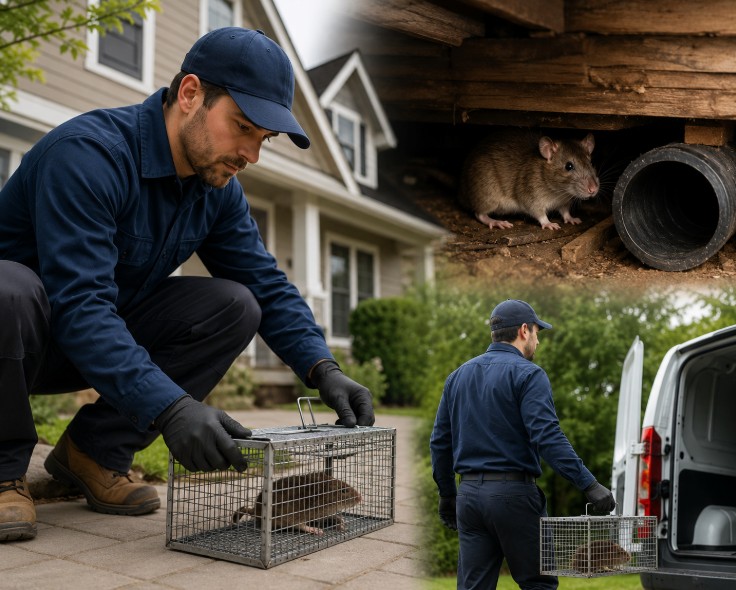
Rodent Trapping in Sacramento
Traps set where the rats already run, checked on a schedule, and cleared by us. You never have to touch one.
Professional Trapping Program
- Attics, crawl spaces, garages and yards
- Every trap checked and emptied by us
- No poison left in your house
- Licensed and insured
Since California took most rat poisons off the table in 2025, trapping is how rats and mice really get removed from Sacramento houses. That suits us. A trap gives you a body you can count and carry out, not a smell in the wall.
But a trap only works where the animal already runs, and each of our three rodents runs somewhere different. This page is how we handle each one.
Where rodent traps go in a Sacramento home
| Rodent | Where it runs | How the traps are set | Bait | Spacing |
|---|---|---|---|---|
| Roof rat | Rafters, wall tops, pipes, fence tops, fruit trees | Off the ground and fastened down | Nuts, dried fruit | 10 to 20 feet |
| Norway rat | Crawl space sills, foundation walls, burrows by the slab | On the ground, tight to the wall, trigger end toward it | Nuts, bacon, dry pet food | 10 to 20 feet |
| House mouse | Garage walls, under sinks, behind the stove | Along walls and in corners, in pairs | A dab of peanut butter, or cotton for nesting | No more than 10 feet |
Roof rat trapping
High Elevation RunwaysAttic noise here is most often roof rats, from the tree-lined blocks of East Sacramento, Land Park and Curtis Park to the tile-roof streets of Natomas and Elk Grove. Roof rats travel high. In an attic that means rafters, the tops of walls, pipes and ducts, so a trap laid flat in the middle of the floor mostly catches dust.
Each trap gets fastened to what it sits on. A trap that jumps when it fires can miss, and a rat that has been clipped once is very hard to catch again.
Roof rats also distrust anything new. They can ignore a fresh trap for days, sometimes weeks. So the traps often go out baited but not set. The rats feed for a few nights, and then everything is set at once.
Outside, the fence top and the limbs of the orange tree are their roads. Outdoor traps go inside boxes so birds, squirrels and cats can't reach them, and they are set for the night. Each one is tied down, because a scavenger will carry off a trap with a rat in it.
As for bait: in a town where rats live on oranges, figs and walnuts, cheese is a waste. We use nuts and dried fruit, a piece the size of a pea, tied or pressed onto the trigger so it can't be lifted off.
Norway rat trapping
Ground & Crawl SpaceNorway rats are the ground crew. Under the raised-foundation houses of Midtown, East Sacramento, Oak Park and Land Park they run the sill and the foundation wall and dig along the footing.
Traps go on the ground against the wall, set crosswise with the trigger end almost touching it. Where a trap has to sit lengthwise, two go in back to back, so a rat coming from either direction meets a trigger. Outside, traps go under cover near the burrow openings.
Mouse trapping
Wall Edges & InteriorMice live small. A house mouse seldom goes more than 30 feet from its nest, so traps go close together, no more than 10 feet apart, right where the droppings are. That usually means the garage wall, under the kitchen sink, behind the stove and the water heater closet.
We set them in pairs an inch or two apart, because a mouse will jump a single trap. Bait is a tiny dab of peanut butter, or a wisp of cotton. A female building a nest will go for the cotton.
Mice move indoors in autumn when the nights turn cold, which is when Sacramento garages get them. Homes that back onto fields and canals, as many do in Natomas and Elk Grove, are especially exposed.
The traps we use, and the ones we don't
Snap traps
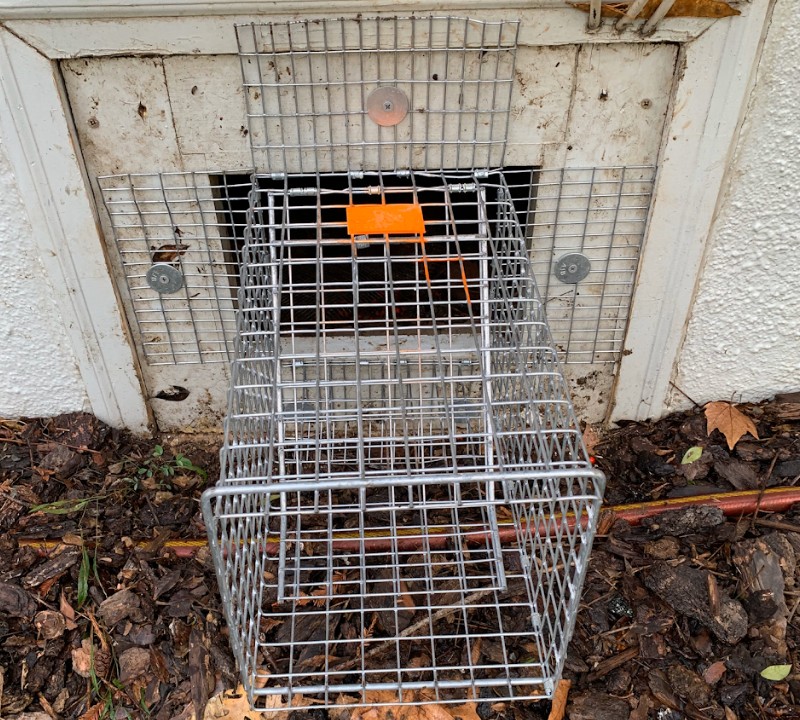
Primary ToolOur main tool, sized to the animal. A mouse trap won't hold a rat, and a rat trap often won't fire for a mouse. University of California pest advisers rate them the safest, most effective and most economical way to trap rats.
Electronic traps
SpecializedThey kill with a shock. Useful where a snap trap can't sit, but they need checking often.
Multiple-catch mouse traps
CommercialThey hold several mice without being reset. We use them mainly in commercial buildings, and they have to be emptied often.
Glue boards
AvoidedNever outdoors, where birds and other wildlife get stuck. We avoid them indoors too. Adult rodents learn to step around them, and an animal caught on one does not die quickly.
Catch and release
Not PermittedNot for rats and mice. California does not allow live wildlife, house mice included, to be moved off the property where it was caught without a state permit. It would not work anyway: mice carried half a mile away have found their way back.
Why store-bought traps often fail
When home trapping fails, it is usually for one of five reasons.
A heavily infested house can need a dozen or more. Two from the hardware store won't do it.
Roof rats were running the rafters and the traps were on the floor.
The rats were still suspicious. One trap fired, missed, and taught the rest.
A big smear of peanut butter gets licked off without tripping anything.
Every rat caught was replaced by one from the yard.
Kids, pets and backyard wildlife
Attic and crawl space traps are out of everyone's reach. Traps in garages, kitchens and yards go inside closed boxes or stations. You get a count of every trap and where it is, so none is forgotten when the job ends.
What happens after the catch
We come back, check every trap, take away what was caught and move any trap that isn't producing. Dead rodents are bagged and leave with us.
A Sacramento attic in July is far hotter than the yard, and a dead rat does not keep. Summer visits are closer together for that reason.
How long rodent trapping takes
Trapping ends when the traps stay empty and no fresh droppings appear. It does not end on a calendar date. Federal health guidance is to keep traps going for at least a week after the last catch.
With roof rats, the first nights are often quiet while they get used to the traps. Most houses take between two and six weeks from the first visit.
Trapping and sealing go together
Trap without sealing and new rats replace the ones you caught. Seal without trapping and you have locked rats inside the house. So the two are planned as one job: the inspection finds the openings, trapping clears what is inside, and exclusion closes the house. That matters most from October to February, when rodents across Sacramento are looking for a way indoors.
What rodent trapping costs in Sacramento
There is no flat price, because a trapping job is mostly visits, and the number of visits depends on the house. These are the things that move it:
- How many areas. Attic only, or attic, crawl space and yard.
- Which rodent. Roof rats take longer because they avoid new traps.
- Access. A tight crawl space or a low-pitched attic slows every visit.
- How long they have been there. A settled colony takes more traps and more trips than a few newcomers.
- Whether sealing is part of the job. Done together, trapping finishes sooner.
A price for "setting traps" with no return visits is a price for half the job.
Our price comes in writing before any trap is set.