
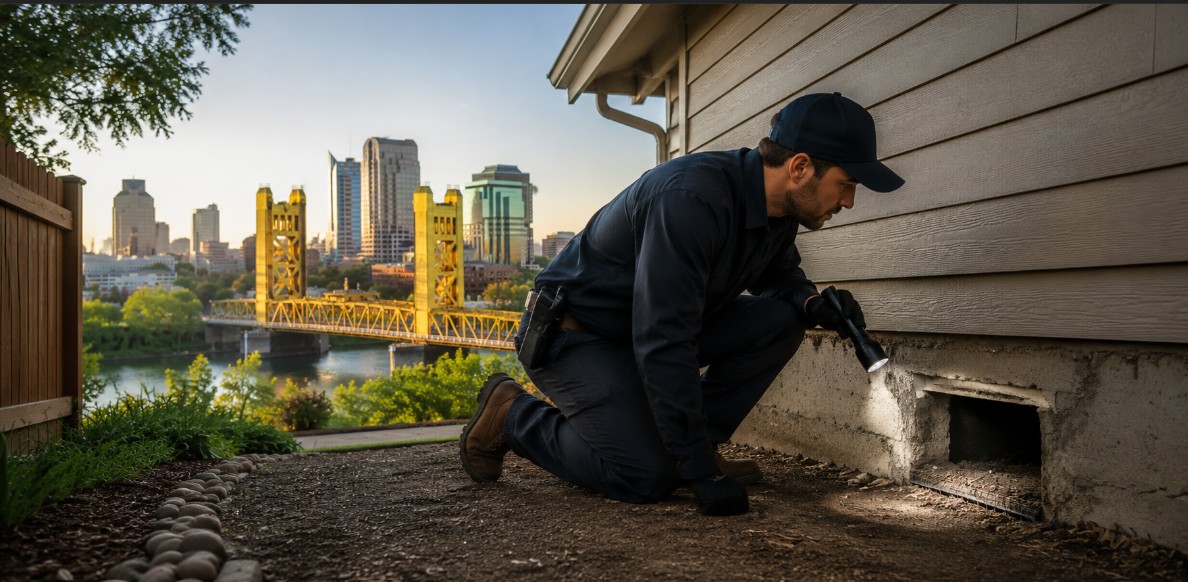
Rodent Home Inspection in Sacramento
We check the roof, the attic, the crawl space and the yard, then show you a photo of every place a rat or mouse is getting in.
What Every Inspection Includes
- Roof to crawl space, nothing skipped
- Photos and a written report
- No chemicals used during an inspection
- Licensed and insured
A rodent inspection has one job: to turn "I think I heard something" into facts you can act on. By the end you should know four things. Which animal it is. How active it is. Exactly how it is getting in. And what it will take to stop it.
Very little of that can be learned from the hallway. In Sacramento the answers are usually on the roof, in the attic or under the floor, so that is where we go.
Which Animal
Roof rat, Norway rat, house mouse or deer mouse. Behavior dictates the trap placement.
How Active
Single explorer or an established family nesting cycle with active runways.
How It Gets In
Every roofline gap, crawl space vent, weep screed, pipe penetration and crawl hole.
What Stops It
Precise exclusion specs, trap lines, cleanup requirements and lasting prevention.
When to book a rodent inspection
You hear scratching or running in the ceiling or walls after dark.
You find droppings in the garage, the pantry or near the attic hatch.
Oranges on your tree are hollowed out, or you see rats on the fence at dusk.
You are buying a house, especially one with a raised foundation or big trees over the roof.
You have just moved in and don't know the home's history.
A neighbor has had rats. Roof rats range 300 feet or more.
It is early fall. October to February is when rodents most often move indoors, so a September inspection finds the openings before they do.
Where we look
Every home is different, but a standard inspection covers five areas:
The roof and roofline
Valley flashing, tile gaps, dormer corners, lead jacks around plumbing stacks, ridge caps, and attic vents. Roof rats use phone drops, fences, and overhanging limbs to reach the gutters, then work along the fascia until they find a gap. In Sacramento, the wire mesh behind attic gable and dormer vents is often rusted through or pulled loose.
The attic
We look for compressed insulation where rats run trails, fresh versus old droppings (which tells us if an infestation is active or historic), nesting sites under ductwork, chewed electrical wiring, and urine staining along ceiling joists. We photograph everything so you see what we see without having to climb up.
The crawl space and foundation
Sub-floor vents with damaged screen, openings around plumbing penetrations (especially under kitchens and bathrooms), gaps where additions meet the original foundation, and burrow holes along the interior foundation wall. Norway rats dig under footings; mice squeeze through openings smaller than a nickel.
The exterior walls and ground level
Weep screeds along stucco bases, gaps where siding meets the foundation, garage door seals (the rubber corners are a common mouse entry), air conditioner refrigerant line penetrations, and dryer exhaust vents with missing or broken dampers.
The yard and property edge
Citrus and fruit trees (especially oranges and figs), ivy and dense ground cover against the foundation, woodpiles, compost bins, dog food bowls, bird feeders, and open sewer cleanout caps. Rats living in the yard are usually what feeds an attic problem.
Tools we use
Most of what we find comes down to good lights and knowing where to look, but a few tools tell us what the eye misses:
Thermal imaging camera
Finds heat signatures of rodents moving through wall voids or resting under attic insulation without opening drywall.
Inspection borescope
A lighted camera on a flexible wand lets us look behind bath traps, inside plumbing chases and down wall cavities through existing gaps.
UV blacklight
Fresh rodent urine fluoresces bright yellow-green under ultraviolet light, revealing invisible runways along pipes, rafters and baseboards.
Tracking dust
A light dusting across a suspected opening shows footprints by the next visit.
Ready to find out exactly what's up there?
Same-day Sacramento inspections available. Open every day 9 a.m. to 8 p.m. Complete photo documentation of every opening.
What changes with the type of house
| House | Where the extra time goes |
|---|---|
| High-water bungalows and other raised-foundation homes in Midtown, East Sacramento, Curtis Park, Oak Park and Land Park | Foundation vents, the crawl space or basement, old additions, trees over the roof |
| Mid-century single-story homes in Arden-Arcade, Carmichael, Tahoe Park and South Land Park | Roofline junctions, gable vents, plumbing stacks, garage door corners |
| Tile-roof homes on slabs in Natomas, Elk Grove and the newer parts of Rancho Cordova and Roseville | Tile ends at the eave, air conditioner line holes, fences that back onto fields or canals |
What you get at the end
A written report, with photos, that covers:
-
1
Which rodent it is, and whether the activity is current or old.
-
2
Every opening we found, with a photo of each and where it is on the house.
-
3
Damage we saw: wiring, ducts, insulation. We flag anything that needs an electrician, a plumber or an HVAC company.
-
4
What on the property is feeding the problem, such as fruit, ivy, pet food or stored clutter.
-
5
A plan to fix it and a written price.
Buying a house in Sacramento? The termite report won't cover rodents
A California home sale usually comes with a termite report and a general home inspection. Neither one is a rodent inspection.
The termite report is officially a Wood Destroying Pests and Organisms Inspection Report. State law limits it to exactly that: termites, wood-boring beetles and fungus. Rats and mice are outside its scope.
General home inspectors work to standards that say they are not required to look for evidence of rodents. Many will mention droppings if they see them. Tracing the entry points is not their job.
Seller disclosures only cover what the seller knows about.
So if the house has a crawl space, mature trees over the roof, or has sat empty, book a rodent inspection inside your contingency period. Sealing work and insulation replacement are easier to negotiate before you close than after. Tell us your deadline when you call. Same-day inspections are available.
How to get ready
Clear a path to the attic hatch and the crawl space hatch.
Unlock the side gates and bring the dogs inside.
Leave any droppings where they are. They are evidence, and sweeping them is a health risk anyway.
Write down where and when you hear noise.
Tell us about recent work on the house: roofing, solar, heating and air, plumbing, cable. New work can mean new holes.
How long it takes
A single-story house on a slab goes fastest. Add time for a crawl space, a second story, a tile roof or a detached garage. We give you a time window when you book.
What a rodent inspection costs in Sacramento
There is no single price, because the work differs from house to house. These are the things that move the fee:
Whatever the fee, this is what it should buy from any company:
- 1 Someone on the roof and, if there is one, in the crawl space.
- 2 A look in the attic, not only at the hatch.
- 3 Photos of every opening.
- 4 A written report you can keep.
- 5 A repair price that is separate from the inspection.
Three questions worth asking before you book anyone:
Do you go on the roof and under the house? Do I get the photos and report in writing? Is the inspection fee credited if I go ahead with the work?
We tell you our inspection fee when you call, before anything is booked.
Questions about rodent inspections
Straightforward facts on what happens when we arrive, rental tenant rights under California law, and distinguishing rats from squirrels.
Do I need to be home?
For the first visit, yes, or someone who can let us into the garage and to the attic hatch. It also helps to hear from you where the noise has been.
Are any chemicals used?
No. An inspection is looking, measuring and photographing. Nothing is sprayed or set.
I only heard it once. Is an inspection worth it?
One noise alone may be a branch or a squirrel on the roof. One noise plus droppings, or noise on several nights, is worth a look.
What if you find nothing?
Then you get a list of the openings that could let rodents in later. That is the cheapest moment to close them.
Could it be squirrels instead of rats?
It could. Squirrels are active by day, mostly early morning and late afternoon. Rats and mice are active at night. The droppings and the entry hole settle it, and we tell you which it is. See attic squirrel removal.
Do you inspect rentals?
Yes, for landlords, property managers and tenants. If you rent, tell your landlord in writing first. California law treats a rodent infestation as a habitability problem.
Need a comprehensive rodent inspection in Sacramento?
We check the roof, attic, crawl space, and exterior perimeter, giving you exact photo documentation of every opening.